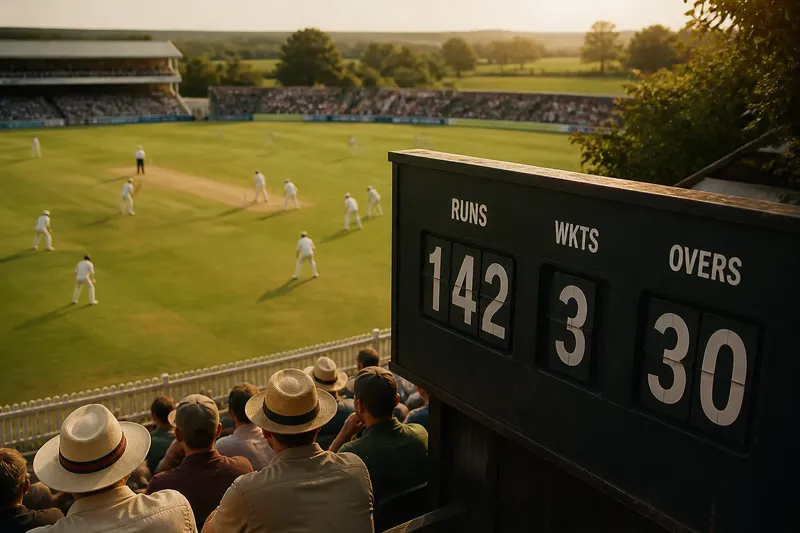
From Timed Innings to Limited Overs: Cricket’s Changing Formats
Cricket’s changing formats make more sense when you see how a fixed end reshaped innings, risk and the value of a wicket without removing strategy.

Cricket’s changing formats are easiest to follow when you notice what ends an innings: a declaration or the close of play in a timed match, and a completed quota of overs in a limited-overs match. That difference changes how batters spend time, how captains ration bowlers and what the scoreboard asks you to watch.
The game did not simply become shorter. Its structure acquired a different kind of pressure: in one format, time can run out before a side is dismissed; in another, a side must use its allotted overs before its innings ends. That shift reshaped the pace of play while leaving the basic contest—batters scoring runs, bowlers taking wickets—recognisably intact.
What does “timed innings” mean in cricket?
In long-form cricket, a match is scheduled across days, and each side may bat more than once. In a two-innings match, the first side bats until it is dismissed or declares its innings closed. The other side then bats, and the sequence may continue through a second innings for each team.
A declaration is a captain’s decision to stop batting while wickets remain. It can give the opposition time to bat and leave the declaring side an opportunity to dismiss it before the match ends. That choice makes the clock part of the contest: a large total is useful, but not if it leaves too little time to bowl the other side out.
In a match with a set playing period, the scheduled close can arrive with the result undecided. The teams may have scored heavily without dismissing one another enough times to complete the innings. In that case, the match can be drawn rather than awarded to the side with more runs. A draw is not the same as a tie: a tie means the scores are level under the applicable match conditions.
When watching a timed match, notice not only the score but also the remaining time and innings still to come. They explain why a captain may declare, why a batter may defend rather than attack, and why a side behind on runs may still be pursuing a result.
Why did a fixed number of overs change the innings?
Limited-overs cricket gives each team a set number of overs in an innings. An over consists of six legal balls, though an illegal delivery does not count towards that over and must be replaced. The innings normally ends when the side is dismissed or has used its allotted overs, whichever comes first.
That fixed ceiling removes the need to spend days completing several innings. It also turns unused time into unused scoring opportunity: a side cannot keep batting beyond its quota simply because wickets remain. The innings therefore has a boundary known in advance, and batters must decide how to allocate risk within it.
The idea emerged as a way to make matches finish within a more predictable period and give spectators a clear contest with a defined endpoint. The structural change was modest on paper—limit the overs—but broad in effect. Every over became a finite resource, and every wicket became a possible interruption to the scoring plan.
Limited overs does not mean that every ball should be attacked. A batter dismissed early cannot contribute later, while a cautious start can leave too much work for the remaining batters. The judgement lies in balancing survival and scoring against the number of overs and wickets still available.
How do innings differ across limited-overs formats?
One-day cricket gives each side a substantial but finite innings, usually divided into an early phase with restrictions on field placement, a middle phase and a closing phase. The exact playing conditions vary by competition, so a viewer should check the match’s rules for the quota and fielding restrictions.
The phases are useful as a way to read the innings, not as separate mini-games. Early batters may take advantage of fielding limits while preserving wickets; the middle overs can involve consolidation or targeted scoring; late batters may take more risk because few overs remain. A wicket in any phase changes which batters are available to finish the innings.
In the shortest standard international format, each side has a smaller overs quota than in one-day cricket. The shorter horizon tends to make a quiet passage more costly, since there are fewer later overs in which to recover the scoring rate. Yet even here, a batter’s role depends on the match situation: a side chasing a manageable target may value a wicket in hand more than an immediate flourish.
These formats also differ in how a chase is read. A target gives the pursuing side a clear objective, but the required rate is only a guide. It can rise after a quiet over or fall after a boundary, while wickets lost affect how safely the remaining batters can pursue it.
What does a fixed quota change for captains and batters?
In timed cricket, a captain can weigh the value of further runs against the time needed to bowl. In limited-overs cricket, a captain cannot extend the innings to gather a few more: the quota itself sets the ceiling. The captain’s decisions instead centre on how to use the available overs and which bowlers should deliver them.
Bowling quotas make the allocation visible. In many limited-overs competitions, each bowler is restricted to a share of the innings, with the precise limit set by the format and competition. Captains have to reserve overs for particular conditions or batters, while also handling a bowler who is being attacked or has a favourable match-up.
Batting order becomes more flexible in response. A team may send a batter known for quick scoring to face a short burst of overs, or promote a steadier batter when wickets have fallen. These are tactical choices, not fixed job descriptions; the same player can be used differently in another innings.
Imagine a side chasing a target with a few overs remaining and several wickets still in hand. Its captain might hold back a strong hitter for the final overs while asking a composed batter to keep the chase stable in the meantime. The observable result would be a late change in scoring intent, not a promise that the target will be reached.
Why do wickets matter differently when overs are limited?
In any format, losing a wicket removes a batter and brings in another. In a timed innings, a side may have time to rebuild after a collapse, though the opposition can use that time to bowl it out. In limited-overs cricket, a collapse also consumes the batting resources needed to make use of the remaining overs.
That creates a tension between two forms of value. A wicket in hand offers the option to attack later; an over used cautiously cannot be recovered. The balance shifts as the innings progresses, which is why the same scoring rate can be sensible early and inadequate near the end.
A target adds another layer. The pursuing side can compare its current score with the runs still needed, but should also note how many batters remain and how many overs are left. A comfortable run requirement with few wickets in hand may be more precarious than the arithmetic first suggests.
In timed matches, the equivalent reading includes the state of both innings and the time remaining. A side with a lead may be trying to force a result rather than simply extend that lead; the side behind may be defending through survival. The scoreboard is a snapshot, while the match structure explains what each side needs next.
How should you read a format’s structure during a match?
Start with the innings rules, then follow the resources that can run out. In a timed match, those resources include time, wickets and innings still to be completed. In limited-overs cricket, track the overs remaining alongside wickets, target and bowlers’ unused quotas.
These questions help identify what is driving the next decision:
- How many innings does each side have, and has a captain declared?
- Is the match controlled by a scheduled close or by an overs quota?
- How many wickets remain for the batting side?
- In a chase, how many runs are needed and how many overs remain?
- Which bowlers still have overs available under the competition’s rules?
The answers do not tell you exactly what a captain will do. They show which choices are open and why a side might favour patience, attack or a change of bowler. For rules that differ between competitions, rely on the match conditions rather than assuming every version uses the same limits.
What do readers often ask about cricket formats?
Can a timed cricket match end without a winner?
Yes. If the scheduled playing time ends before the conditions for a win are met, the match can be drawn. A tie is different: it means the scores are level under the match’s rules.
Does a limited-overs innings always use its full quota?
No. An innings can end early if the batting side is dismissed, or if it reaches a target while chasing. The quota sets the maximum opportunity to bat, not a requirement to use every over.
Why do teams not attack from the first ball?
An aggressive start can score quickly but may also cost early wickets. Batters and captains judge how much risk the remaining overs, wickets and match situation can bear.
Is one format simply faster than another?
Limited-overs matches have a more defined endpoint, but pace within an innings still varies. A long-form match can contain brisk scoring, while a limited-overs innings can include careful passages shaped by wickets or a difficult chase.
What is the most useful way to compare the formats?
Think of timed cricket as a contest in which runs, wickets and time interact, and limited-overs cricket as a contest in which runs, wickets and a fixed supply of overs interact. That distinction is the heart of cricket’s changing formats: a match’s endpoint changes the value of patience without making patience disappear.
When the next decision seems surprising, look at what the side can still spend. A declaration spends time to seek a result; a late batting surge spends wickets for runs; a cautious over preserves batters but uses an over that cannot return. The format makes those trade-offs legible, one decision at a time.