The Scoreboard Is Not a Countdown
A cricket scoreboard makes more sense when runs, wickets and overs are read separately, revealing scoring pace, remaining resources and the innings’ shape.
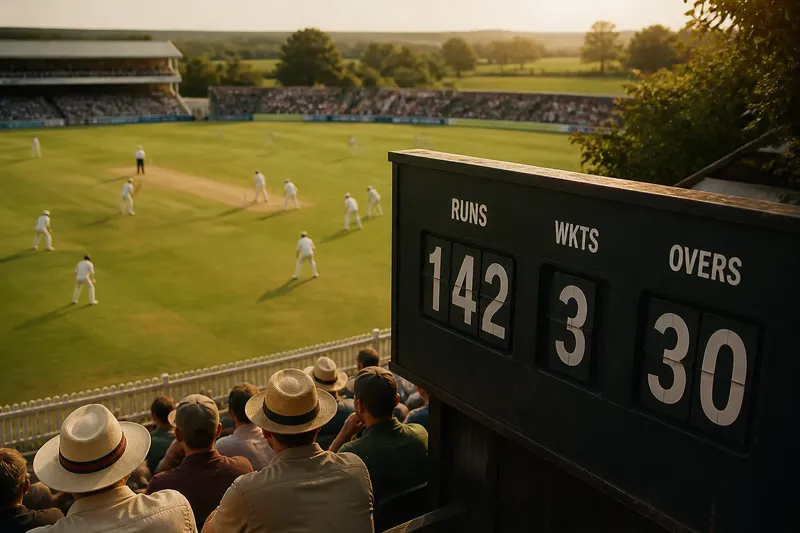
A cricket scoreboard showing 142 for 3 after 30 overs does not say that the innings is nearly finished. It tells you how many runs have been scored, how many batters have been dismissed and how much of the allotted overs has been used. The cricket scoreboard is not a countdown: each figure describes a different part of the match, and reading them together gives a better account than treating them as one progress bar.
Here are five ways to separate those clues and see what the innings may be doing.
1. What do the runs tell you?
Runs are the score accumulated so far, not a direct measure of how comfortably an innings is progressing. A team can collect them steadily through singles, or quickly through boundaries; the same total can therefore have quite different causes and different implications for what comes next.
Look for the pattern behind the number. A total built from regular singles and twos may suggest that the batters are keeping the strike moving. A run of boundaries can lift the score sharply, but may also reflect a brief spell of attacking play rather than a pace the side can sustain.
Suppose, in an invented situation, a side has 40 runs after eight overs, with two wickets down. If the batters have mostly taken singles, the score may have come from a stable partnership; if it came from several boundaries between quiet overs, the innings has been more uneven. The scoreboard alone cannot tell you which pattern occurred, but the over-by-over figures can.
2. Why do wickets change the reading?
Wickets count dismissals, but they also indicate how many recognised batters remain available. Losing one wicket is not simply subtracting a run from a total; it changes who must bat next and can alter how freely the current pair is able to play.
Compare 120 for 2 with 120 for 7. The runs are identical, yet the second side has far fewer specialist batters to come. It may need to protect the lower order, or it may have no choice but to attack before the innings ends. Neither response is automatic: the batters at the crease, the match situation and the conditions all matter.
Wickets can also arrive in a cluster. If a side loses several in quick succession, a reasonable score may suddenly look vulnerable because the next batters are entering without much time to settle. One dismissal is an event; a sequence of dismissals can become the innings’ defining pattern.
3. What do overs measure?
Overs show how much bowling has been completed. In a limited-overs innings, the allotted overs place a boundary on how long the batting side can continue, so the number used tells you how much of that opportunity has passed. In a Test innings, there is no fixed overs allowance for the batting side, so overs are context rather than a countdown to an automatic end.
Overs also help explain scoring pace. A total of 90 after 15 overs has a different tempo from 90 after 30, even though the run column matches. The first side has scored more rapidly so far; whether that is sensible depends on its wickets in hand, the format and what the match requires.
Read the overs alongside wickets, not instead of them. A quick score with many wickets lost can leave the remaining batters exposed; a slower score with few wickets down may give them room to accelerate later.
4. How does the cricket scoreboard show innings tempo?
Tempo is the relationship between runs, wickets and overs, not a separate number printed beside them. The same run rate can conceal a calm innings, a boundary-driven burst or a recovery after early trouble. To see which, watch how the score changes from one over to the next and note when wickets fall.
In limited-overs cricket, compare the current scoring pace with the innings’ remaining overs and the wickets still available. This is not a prediction of the final total. It is a way to notice whether the batters appear to be building, accelerating or trying to recover.
In a Test, the question shifts. A team may score slowly while batting for time, or declare its innings before all its batters are out. The scoreboard still records runs, wickets and overs, but the side’s purpose cannot be inferred from those columns alone; the state of the match matters.
5. Which questions make the figures useful?
Does a higher score always mean a stronger position?
No. Runs matter, but a side with many wickets down may have limited batting left, while its opponent may still have time or overs to respond. Position depends on the format and match situation as well as the total.
Why does the same score look different in different formats?
A limited-overs total is framed by a set number of overs, so the remaining allowance is part of the reading. In a Test, innings can continue until the side is dismissed or declares, and the match can turn on time, follow-on possibilities and the other team’s score.
What should I check after a wicket falls?
Note the score and over, then consider who is coming in and how many wickets remain. A dismissal during a steady partnership may be manageable; several close together can change the batting side’s options more sharply.
Can overs tell me whether the batters are scoring quickly?
They can help, when read against the runs scored. Compare the total with the completed overs, then check whether boundaries, singles or quiet spells produced it; the over count on its own says nothing about scoring pace.
What should you read next?
When following a live match, start with the score, then ask three separate questions: how many runs are on the board, how many wickets remain, and how much of the innings’ available time or overs has been used? Add the recent pattern of scoring and dismissals before deciding whether the side is building, pressing or in trouble.
That habit makes the cricket scoreboard more useful without pretending it can explain everything. The figures describe the innings; the batters’ choices and the match situation explain why those figures matter.